
SPC Flooring Click-Lock Systems: What Buyers Should Know
2026-11-06SPC flooring has 3 areas to consider: how well the planks stick together, what you hear as you walk through your room and how flat the subfloor needs to be. The first one is the click-lock system and it actually works for all three, but you might not be clear with your specifications. The best part of the guide is that it will cover aspects such as how SPC click-lock flooring really works, what actually changes while installation and in labor terms along with subfloor & underlayment solutions which help ensure a successful (damage-free) click lock install followed by order parameters minimum order quantity (MOQ), lead time and custom variations — all things to understand before placing container deposit!
How SPC Click-Lock Flooring Works
SPC (stone plastic composite) flooring has a core made from calcium carbonate and PVC, along with decorative and wear layers. Click lock features a tongue and groove edge profile. The male tongue on the opposite side of each plank can match with female groove on adjacent plank. That means no-glue mechanical locking. This is an interlocking profile for the joint that makes use of certain machined tolerances such that it locks in situ when inserted according to its locking method. The installation process is fast since the last row clicks in, which often means you can walk on your floor same day without glue or trowelling needed (no adhesive curing time required).
Generally, each plank has three main layers: decorative layer (this is partly what makes the ‘beauty’ you are buying), wear layer (the scratch-resistant or abrasive surface that “touches” either foot traffic and/or furniture) and SPC core with an edge lock profile at edges which connects adjacent planks. One line: the joint exits our factory, then you close it again on site.
What Click-Lock Means for Installation and Labour
So you are dealing with mechanically fastened joints, and click lock SPC alters the economics of installing this floor. Unlike glue-down flooring, click-lock planks sit atop a previously prepared subfloor (as well as moisture barrier or approved underlayment when necessary). The work on flooring moves from mixing and spreading, to lining up planks in rows. That is why click-lock works great in showrooms, offices and hospitality areas where you want the crew to be done as soon as possible so that you’re paying for labor for the least amount of time, because often a trained crew can finish an area quicker than if they installed something using adhesive. On a multi-storey or staged job, though, that speed is not merely very nice; it may be the difference between making it there and being late.
The tools you need are limited: a measuring square, circular saw or jigsaw and also, if allowed, a tapping block as well as pull bar. After that, where a DPM or other underlayment is needed and permitted by the manufacturer, it’s used. There is no adhesive trowel, and you also have no adhesive curing period. As for measuring, build in a suitable material allowance when you are cutting and staggering rows—your order should cover both the area you want to assemble PLUS this buffer.
Subfloor, Underlayment, and the Expansion Gap
Outside of the individual plank itself, there are three factors that influence how well click-lock floorboards perform. First, the subfloor. It must be clean, dry and flat to the flooring manufacturer’s tolerance. An uneven subfloor can cause movement under your feet leading to creaking noises and putting additional stress on the locking joints. A flexible subfloor leads to movement underfoot, creaks and extra stress on the locking joints.
Second, the underlayment. Crossreference this with your total finished depth of floor finish, whether you want additional thermal isolation or soundproofing for a first-floor apartment and the correspondence to whatever underfloor heating apparatus is run below. Very soft or thick padding will additionally create an excessive amount of movement, which means the locking joints are stressed.
Third, the expansion gap — leave the clear space specified by manufacturers between walls, door frames and fixed verticals in which a floating floor can give way to temperature changes as opposed to causing a row to buckle. This limited room for growth can result in lifting or buckling.
SPC Click-Lock Flooring for Home and Commercial Use
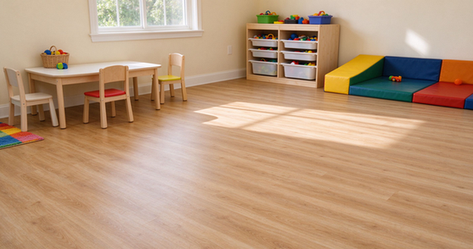
SPC planks that SINCERE runs features from 110 × 610 mm to floor plank size of 230 × 1828 mm and the thickness options around 2.0–8.0 mm for residential homes or commercial spaces. Your choice should not be based exclusively on plank width or overall thickness; it hinges upon traffic, wear-layer thickness and performance of the locking joint. Both are capable of working with the same click-lock format. Performance: water-resistant, wear-resistant and scratch resistant; check product test reports for fire performance and formaldehyde emissions. Note: SPC core itself is waterresistant, but clickjoint seams are not fully waterproof; standing water should be avoided.That is the type of profile that enables a showroom and hotel corridor, clinic or apartment to use click-lock SPC if the selected product meets site performance and installation requirements.
Sizing Your Order: MOQ, Lead Time, and Custom Options
What this basically means is that click-lock does not directly change commercial terms (such as the price you are being charged) but it changes what you need to confirm before ordering because profile and underlayment are order-level details.Check whether MOQ applies to the whole order or each colour and specification. The lead time for custom production may be approximately 25–30 days after the sample is confirmed depending on order. You will also need to verify the service scope by specification of CAD drawings for construction and visualization in 3D. So ask if a 30% deposit applies and confirm when the rest is due before the bill of lading gets released. Just like any other structural specification, confirming the lock profile underlayment compatibility and expansion-gap detail in writing during the RFQ stage is best practice.
Conclusion
This is a very simple specification, so it can be hard to overthink — the three elements that determine its performance are the clicking mechanism you use, what subfloor your SPC floor floats on top of and how much gap you leave around it. Choose a plank size and thickness that relate to the site traffic, inspect and level the subfloor if needed, plus stick with underlayment guidelines depending on your final floor thickness in addition to your underfloor heating system. Leave an expansion gap according to what your manufacturer’s instructions request. Touch these and the floor clicks in fast, with minimal risk of noise.
For a finished example of the same system on a commercial floor, the SPC showroom case shows the format in a high-traffic space — a useful reference before you size your own order.
FAQ
Q: Do SPC click-lock floors need adhesive?
No. Locking the planks mechanically with a tongue-and-groove profile. A floating system: The floor is not actually glued to the subfloor, but laid down over a prepared subfloor including a moisture barrier or other approved underlayment when required. It can often be walked on straight after install – follow the manufacturers instructions.
Q: Why does a click-lock floor creak, and how do you stop it?
Creaking can occur due to subfloors that have not been prepared flat enough, too much movement of the floor boards themselves during normal use and finally locking-joint failure or lack of expansion space. Leave the gap for expansion required by manufacturer at walls and any fixed verticals, keep your subfloor flat so that joints lie flat and use an underlayment that does not exceed the thickness allowed by the manufacturer. Those issues can be fixed to make the common noises lower.
Q: What size SPC plank should a buyer choose?
This means that the specification and traffic must be aligned. SINCERE SPC ranges in sizes from 110 × 610 mm all the way to 230 × 1828 mm, with thickness options around 2.0–8.0 mm. For residential or commercial flooring, look for suitable wear-layer thickness and locking-joint performance by company recommendations such as residential, workplace, hallway and showrooms.


